| |
click
for travel information on the country
The
name 'Argentina'
Comes from the Latin argentum which means silver. The origin of
the name goes back to the voyages made by the first Spanish conquistadores
(conquerors) to the Río de la Plata. The shipwrecked survivors
of the expedition mounted by Juan Díaz de Solís discovered Indians
in the region who presented them with silver objects. The news
about the legendary Sierra del Plata, a mountain rich in silver,
reached Spain around 1524. From this date the Portuguese named
the river of Solís, the Silver River (Río de la Plata). Two years
later the Spanish used the same name. Since 1860 the official
name of the country has been the República Argentina (Republic
of Argentina).
Geography
Its North-South extension of 3,800 km and its area of 3,761,274
sq. km, gives Argentina a great variety of climates and landscapes.
The Pampas, one of the three largest fertile plains
in the world, cover approximately a third of the country’s
surface, with a temperate and humid climate.
To the south is Patagonia, an immense and plateau
bordered on the west by the southern end of the Andes range. This
mountain chain changes according to latitude. In the south it
is covered with forests, lakes and glaciers, with a cold and damp
climate. In the center the Andes has the highest peaks in the
Americas and the Cuyo region, which is known in the local Indian
language as "the desert country" and has become nowadays
in a fertil productive area.
In the Northwest region, the Andean mountains,
the desert plateau of the Funa, the valleys, the gorges, the multicolored
hills and the picturesque villages come together to endow the
area with vigorous and contrasting physical and cultural features.
In the central region, the Pampa Hills, a feral
area of hills, escarpments and waterfalls alternate with valleys
and plains with a temperate climate.
The Chaco, in the country's middle north, is a
vast wooded plain with marshes and lakes.
To the northeast, bracketed by the big Paraná
and Uruguay rivers, is the region known as Mesopotamia. In the
north, a subtropical climate and jungle areas, and in the south,
temperate weather with plains suitable for farming.
Government
It is republican, representative and federal, as determined by
the Constitution. Politically the country is divided into 23 provinces
and the federal capital (City of Buenos Aires).
The national president and vice-president, as well as
the head of government of the City of Buenos Aires, the provincial
governors and the members of the legislative bodies are chosen
by the universal, secret and compulsory vote of citizens of either
sex above the age of 1 8. Presidential re-election is Aowed for
one consecutive 4-year period.
Population
The
current population of Argentina is estimated to be some 37 million
of which almost half live in the Federal Capital and the province
of Buenos Aires. These figures give us a population density of
13.2 inhabitants per square kilometre.
95%
of Argentineans are white and principally descendants of Italians
and Spaniards. With the massive European immigration the white
and Indian half castes became slowly diluted until today these
people only amount to 4.5% of the population. The pure indigenous
population, the Mapuches, Collas, Tobas, Matacos and Chiriguanos,
amount to 0.5% of the population.
Economy
A main feature of Argentina is its farming. Grain and oilseeds
are harvested as well as sugarcane, cotton, fruit, "yerba
mate" and grapes. Cattle raising is notable for the size
of the herds; cows, sheep, horses and pigs are bred. The country’s
main industries are those that are derived from agriculture.
As regards mining, there are deposits of metallic minerals
(iron, uranium, lead, tungsten, tin, zinc, gold, copper, silver
and manganese), non-metallic minerals (clays, ordinary salt, gypsum)
and rocks for applications (sands, limestone, pebbles and ground
granite). Among fuels, oil, natural gas and coal are produced.
Fisheries are significant: river, lake and maritime fishing,
the latter along the country's Atlantic coastline.
Over the last years, tourism has strengthened as one
of the main sources of development of the Argentine economy, generating
both employment and investments. Likewise, the increase of the
receptive tourism income has positioned this activity on the first
place within export items.
After the opening up of the Argentine economy and with
its newly found place in international markets, different integration
agreements among the governments of Argentina, Brazil, Paraguay
and Uruguay led to the creation of the Southern Cone Common Market
(MERCOSUR).
Currency
The official Argentine currency is the peso, the value of which
is equivalent to one United States dollar and fluctuates along
with the latter. There are 2, 5, 10, 50 and 1 00 peso bills and
1, 5, 10, 25 and 50 cents and 1 peso coins.
Language
The national language is Spanish. English, French and Italian
are quite widely spoken.
Religion
The official religion is Roman Catholic, although there
is complete freedom of worship for Protestants, Jews, Moslems,
Greek Orthodox and Russian Orthodox.
Culture
It is seen in all its manifestations, cinema, theater, visual
arts, music and literature, with outstanding personalities, many
of whom have worldwide recognition.
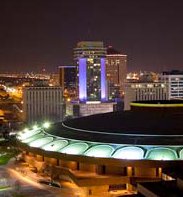
The Colón Theater is ranked among the top three opera
houses in the world with a beautiful
architecture and perfect acoustics. Its wide stage allows great
sets to be built for large casts. The most famous musicians and
ballet-dancers have performed and continue to perform there.
In Buenos Aires there are about 90 theaters and 100 cinemas,
with a large variety of shows. Among the key centers of culture
are the General San Martin, Recoleta and Borges cultural centers.
Painting and sculpture have a key role in cultural life.
The country's principal cities have prestigious art galleries.
There is popular and folklore music and special mention should
be made of the urban music typical of the River Plate area: the
tango. Its idol, Carlos Gardel, was turned into a legend by millions
of fans. Its lyrics and unmistakable beat make the tango a specifically
Buenos Aires phenomenon, yet it continues to triumph abroad.
Five Nobel awards, in diverse fields, have been won by
Argentine men: in physiology and medicine, B. Houssay (1947) and
C. Milstein (1984); in chemistry, L.E Leloir (1970), while C.
de Saavedra Lamas (1936) and A. Pérez Esquivel (1980) received
the peace award.
The Argentine gaucho should be specially mentioned as
described in "Martin Fierro" by the Buenos Aires Province
poet José Hernández. Argentines have inherited from the gauchos
a strong personality, the love of freedom and a permanent quest
for justice. It is thus understandable that, though originally
from the pampas, the gaucho is everywhere in this land.
Sports
One of the great obsessions of Argentines is soccer. The City
of Buenos Aires has 17 stadiums, many of them seating more than
40,000 spectators.
"Pato" is a genuine local sport, and Argentine
polo has acquired an international reputation due to the dexterity
of its players, considered the best in the world.
In recent years other sports have won thousands of young
people over. There are more than 1,500 tennis courts in Buenos
Aires and neighboring areas; in field hockey and roller skate
hockey, Argentina’s teams have won major victories abroad.
In rugby, the 1% national team, the Pumas, has shown its mettle
in diverse world championships. Ski has been boosted by the construction
of new winter-sports centers with very good slopes and modern
ski-lifts. Volleyball and basketball teams also compete at international
level.
Water sports are also practiced in our country. sailing,
power-boating, rafting and canoeing. Argentina's big game hunting
is famous. Dorado and salmon fishing attracts numerous visitors.
And the list goes on to include car-racing, boxing, golf, trekking,
mountain climbing, mountain biking and hang gliding, as well as
the beach sports practiced along the Atlantic coast.
Farms/estancias
The entire Argentine territory is dotted with farming establishments
known as estancias, many of them over 200 years old. Some have
farmhouses, called cascos, which are gorgeous mansions in the
English or French style, luxuriously furnished and very comfortable.
Others, on the other hand, preserve the old and austere colonial
style.
A number of farm owners have opened their establishments
to the public, transforming them into small and exclusive top-notch
hotels. The estancias offer guests a range of activities that
turn their stay into an attractive experience: horse riding, fishing,
birdwatching, polo, golf, etc. as well as diverse farming activities,
such as cattle roundups, milking, cattle branding, sheep marking
and shearing, or watching gauchos breaking in horses or displaying
their riding abilities, as well as enjoying their guitar playing
and folklore dances.
Adventure Tourism
The high mountain peaks, snow-covered mountains and hills are
ideal for mountain climbing and trekking. Lesser heights are used
for hang gliding and paragliding.
Lakes, natural and artificial, offer canoeing and windsurfing.
The Mendoza, Diamante, Atuel, San Juan, Limay, Manso, Hua Hum
and Melinquina rivers, rafting and kayaking.
At the Barreal plain, El Leoncito, there's sailcarting,
a kind of windsurfing on land using tricycles with sails.
Horseback riding and mountain biking are organized in
various parts of the country and allow access to nature's more
out-of-the-way landscapes.
Ski in The Andes
The Catedral (San Carlos de Bariloche, Rio Negro) and Chapelco
(San Martin de los Andes, Neuquén) are international winter sports
centers. In Neuquén Province the Bayo and Caviahue peaks, are
modern winter sports resorts.
Near the town of Esquel (Chubut) is La Hoya, with great
ski slopes. Cross- country skiing is popular at numerous winter
sports centers in Tierra del Fuego Province.
In Mendoza Province, Vallecitos, Los Penitentes and the
famed Las Leflas valley are ski resorts with the most modern facilities.
The season starts in June and ends in September with a great inflow
of skiers and amateurs from around the world.
Food
Meat and wine have given the country an excellent reputation.
The local cuisine is varied and tasty. The Northwest region has
its own specialties: empanadas, tamales, humita, carbonada and
locro.
In addition, however, the strong immigration flows that
populated the country explain the existence of delicious international
cuisine: Italian, Spanish, French, German, Smiss, English, Chilean,
Mexican, Chinese, Japanese, Thai, Arab, Jewish, Basque, Scandinavian,
Greek, Dutch, Hungarian, Russian.
The new Argentine cuisine, created by top-ranking chefs
and encouraged by demanding gourmets, is up to international standards,
competing with the best in the world.
click
for travel information on the country |
|
|